| |
| |
|
|
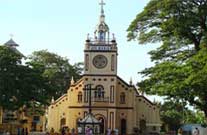 |
Vallarpadam Church |
Kerala, located on the west coast of India, is known as 'God's Own Country' because of its scenic beauty, and Kochi is the shining jewel in this beautiful state. Vallarpadom, which forms part of Kochi, is a small idyllic island on the Vembanad lake, with a serene and calm atmosphere. The serenity and peace, which is a salient feature of this island, can only be attributed to the presence of the historic church of Our Lady of Ransom. This church forms part of the diocese of Verapoly and revered by Catholics as a very sacred church. |
The church was built by Portuguese missionaries in 1524. It is said that the missionaries discovered a painting of the Lady of Ransom, and later in a dream, they were asked to establish a church in Vallarpadam, which they dutifully did. Many miracles have been attributed to the Lady of Ransom and most are of people being saved from accidents at sea. As per tradition the church was earlier known as the church of the Holy Spirit. The original building was destroyed by floods in the 17th century and rebuilt later. The present building is said to have built in 1676. |
As per local folklore, a lady and her child from a Hindu family who were shipwrecked, survived for three days, sheltered under a rock. The lady prayed that she would commit her life to serving the Lady of Ransom, and she was saved. Even today, all processions in connection with festivities of the church begin from the ancestral house of the Hindu lady, which is called Paliath. The images of the lady and child are also seen in the picture of the Lady of Ransom inside the Vallarpadom church |
|
|
| |
|
|
 |
St. Sebastian's church, Arthunkal |
One of the most important pilgrim centres of the Christians in Kerala, popularly known as St. Sebastian Church, 22 kms. north of Alleppey.This church was established by Portuguese missionaries, which is near Sherthallai. Arthunkal is a small seaside village, about 8 kilometre west of Cherthala and 22 kilometre north of the sleepy Alappuzha town, in the Alappuzha district of Kerala state, South India. Primarily a fishing village, this serene neighborhood has witnessed fast development since the late nineties, in sync with Cherthala, a small satellite town of Kochi, the biggest city in Kerala. |
Arthunkal is one of the most important pilgrimage sites in Kerala. It is considered as a holy land by hundreds of thousands of devotees, of Christian as well as other faith. The village is synonymous for its church, which has the Roman martyr Saint Sebastian as its patron. The feast of St. Sebastian in Arthunkal is a grand celebration extending for two weeks in January. While the main day of the traditional feast or the perunnal is on January 20, the church authorities have instituted another on January 27, to mark the end of celebrations, locally referred to as Ettamperunnal or 'the 8th day or the feast'. |
Devotees from all across the state visit the church on the feast days. A procession, carrying the graceful statue of St. Sebastian, from the church to the beach and back, is the most important event of the feast. Interestingly, an eagle is seen roaming the skies, every year during the time of the procession. This eagle too has become part of the grandmother stories, about the presence of St. Sebastian as a guardian saint for the village. |
|
|
| |
|
|
 |
Manjinikkara Church |
Manjinikkara church derives its importance from the holy tomb of late Ignatius Elias III, the Holy Patriarch of Antioch. Members of the Jacobite Syrian Church believe that the Holy Father was a Saint. Situated atop a hillock in Manjanikkara, near Omallur, Pathanamthitta District in South Kerala, this monastery was established by late Mor Yulius Elias Qoro, Patriarchal delegate to Malankara. On February 13th, 1932, the late Patriarch Mor Ignatius Elias III entered eternal rest and his remains are interred at the monastery. (In the photographs of the exterior above, the tomb of the late Patriarch is within the campanile like structure on the south side of the sanctuary.)
The remains of late Mor Yulius Elias Qoro and Mor Yulius Yacoub, former Patriarchal delegates to Malankara are also interred in this church |
The Manjanikkara Dayro is the seat of the Patriarchal Delegate to Malankara (currently, Mor Ostatheos Benyamin Joseph) and the metropolitan of the Simhasana churches (churches administered directly by the Patriarchate). It was a heavenly boon to about 30 families resided at Manjinikara and it’s suburbs to initiate a church in his name as our Patron Saint. They used to travel several miles to attend the Holy Mass in the early years of the Twentieth century. |
Considering the hardships of the believers, Very Rev. Elavinamannil Skaria Malpan in association with the founding members benedicted St.Stephen’s Church Manjinikara on 31st January, 1926, under the apostolic blessings of the Patricarch of Antioch and all the East.
At Present, after eight decades, there are 280 families as members of this church Under the spiritual guidance of H.G. Mor Milithiose Yuhanon Metropolitan Very Rev. Fr. E. K. Mathews Cor-episcopa Elavinamannil serves as the vicar . Sunday school, Martha Mariam Vanitha samajam, 5 Vayana yougams and ‘Elias Mar Yulius’ Youth association function as statutory bodies of the church. |
|
|
| |
|
|
 |
St. Mary’s Church Kattachira |
The chapel of St. Mary’s Jacobite Syrian Church Kattachira, near Kayamkulam in Kerala had been witnessing a miracle, since October 21, 2009. Aromatic oil, resembling tears, has been observed pouring out from the sacred eyes of St. Mary in a flex photograph placed inside the chapel. Although this aromatic oil, with a heavenly fragrance has been repeatedly wiped away, it’s continuously flowing out of this photograph. |
Moreover, since November 21, 2009 aromatic oil has also been observed emerging from the Holy Qurbono Taksa held in the chapel’s madbaha. Similar oil has also been observed flowing from the Holy Cross placed near the photo and the Apostolic Bull of His Holiness Moran Mor Ignatius Zakka I Iwas, declaring the chapel as a Global Marian Pilgrim Centre. |
The Holy Qurbono and intercessory prayers are being held in the chapel on a daily basis where pilgrims from all parts of India are thronging to seek refuge at the lap of Mother Mary. Many non-residents, who visit Kerala during their vacation, also make a bee line to visit and offer their prayers at the chapel. |
|
Although His Holiness the Patriarch has shown keen interest to visit this church, ill health is holding him back. However, rationalists have opined that more investigations are necessary to establish the source and the nature of this aromatic oil. |
|
|
| |
|
|
 |
Sabarimala Temple |
Kerala is a land of temples; perhaps the best known pilgrimage destination in Kerala is Sabarimala, high up in the Sahyadri Mountains (Western Ghats). Sabarimala Sri Dharmasastha Temple is the most famous and prominent among all the Sastha Temples. It is believed that "Parasurama Maharshi" who retrieved Kerala from the sea by throwing his axe, installed the idol of Ayyappa at Sabarimala to worship Lord Ayyappa. |
The pilgrimage begins in the month of November and ends in January. The temple attracts pilgrims not only from the southern states of India, but also from other parts of the country and abroad.
The shrine gets thronged with devotees especially during the main pilgrim season from November to January.
|
Mandalapooja(Nov.17th)and Makaravilakku(Jan.14th)are the two main events of the pilgrim season. The temple stays closed during the rest of the year except for the first five days of every Malayalam month and during Vishu (April). |
Certain customs are to be strictly observed if one has to undertake a pilgrimage to Sabarimala. A pilgrim attending the Mandalapooja should observe austerities for 41 days. During this period, the pilgrim should abstain himself from non- vegetarian habits and cardinal pleasures. |
|
|
| |
|
|
 |
Sri Krishna Temple at Guruvayur |
Guruvayur, near Thrissur in South Kerala, is one of the most popular Hindu pilgrim centers in India .It has the famous temple dedicated to Lord Krishna. Just as the Tirumala Venkateshwara has become popular in Andhra Pradesh, So is this Krishna temple of Guruvayur in Kerala. Like Tirumala, Guruvayur temple also rests on the faith of the devotees, that the Lord fulfils the desires of the devotees.
|
Known as the ‘Dwaraka of the South', Guruvayur temple has very interesting traditions around it. The idol of Sri Krishna at Guruvayur is believed to be an ancient one, which was being worshipped by Brahma himself at Dwaraka. After the pilgrim city of Dwaraka became submerged in the sea, Sri Krishna decided to leave His mortal body at Prabhasa Kshetra in Sourashtra for His heavenly abode. According to tradition, it is believed that Sri.Krishna Himself gave his idol which was at Dwaraka, to His foremost disciple and devotee, Uddhava to be installed in a safe place.
|
As instructed by Sri Krishna, Uddhava sought the help of Guru, the preceptor of the Gods and his disciple Vayu, the God of Winds, in finding an equally holy spot for installing the idol of Krishna . After a long quest for a most suitable site, they entered Kerala, which had been created by Parasurama. They approached Shiva and Parvathi who were staying near a beautiful lake of lotus flowers in Kerala, called Rudra Tirtha. As suggested by Shiva and Parvati and by their blessings, the idol of Krishna was duly installed at the spot beside the lake. As the side was selected by Guru and Vayu, the place came to be called as “Guruvayupura”, which later on became popular as ‘Guruvayur'. Krishna was lovingly called as 'Guruvayurappan' or the Lord of Guruvayur. Shiva and Parvati stayed on the opposite bank of the lake, which came to be called as Mammiyar, where a Shiva temple has now been constructed. It is believed that he original shrine of Krishna at Guruvayur, according to mythology, was built by Vishwakarma, the celestial architect at the instance of Guru and Vayu. |
|
|
| |
|
|
 |
Chottanikkara Temple |
Chottanikkara Bhagavathy Temple is one of the most celebrated Hindu shrines of Kerala. The temple is located in Chottanikkara town, 17kms away from Ernakulam. Rajarajeswari (Adiparasakthi) alias Durga Bhagavathy - the mother Goddess, is the presiding deity of the temple. It is said that this deity was brought from Mookambika Temple in Kollur, Karnataka and therefore there is a presence of Mookambika (Saraswathy) Devi till 7am in the morning.
|
The 'Devi' in the temple is known for the healing powers, particularly relating to mental illness and disorders. The temple situated in a hilly region, is surrounded on all sides by green farms. The entry is through the west and the spiritual atmosphere in the temple gives mental peace and harmony to devotees.
|
In the main temple, the golden hued idol of Bhagavathy 4 to 5 ft. high, is bedecked with flowers, garlands, jewels and bathed in myriad of lights splendidly. The idol has four arms. The upper right holds the disc, the upper left bears the conch, the lower right hand is held in a boon-conferring pose and the lower left indicates the abhaya (fearlessness) pose. The Bhagavathy is worshipped in three different forms as Saraswathy in the morning clothed in an impeccable white garment, Lakshmi at noon with crimson red cloth and Durga in the evening wearing a bright blue dress. Durga is a much milder form. The original idol of Bhagavathy, three or four feet high which faces east, is of laterite and is believed to be self-born (swayambhoo). This image called 'Rudraksha Sila' is irregular in shape, red in colour and is untouched by the human sculptor. This image can be seen only in the wee hours of morning at 4 am when the Nada opens for nirmalyam. |
|
|
| |
|
|
 |
Thrikkuratti Mahadeva Temple |
Thrikkuratti Mahadeva Temple is located at Mannar,an upcoming business town mid way between Mavelikara and Tiruvalla, in Alappuzha District of Kerala state, India, on State highway no. 6. It is situated on the banks of the Pamba River. It is one of the famous 108 Sivalayas built by Lord Parasurama. It is believed that the mammoth temple compound wall was built by a troup of Bhoothas of Lord Paramasiva in one night.
|
The unique festivities of Thrikkuratti temple (Sahasra kalasam, Maikatti puja and Sivarathri Nritham) attracts lot of pilgrims. The antique wooden carving of temple sricovil came to lime light recently through visual media, attracting lot of art lovers including foreigners. At a special Nada (gate) on east side of the temple compound wall, other religious members, in particular, Muslims, present offerings on daily basis. This practice is believed to be centuries old and this is considered to be a true embodiment of religious harmony.
|
The Thrikkuratti Mahasivarathri Festival (only next to Aluva sivarathri in terms of mass congregation) and Its well known procession with decorated floats, Kavadi aattam, Amman Kudom, Thaiyyam, and cultural stills etc, attracts thousands of devotees and tourists. The west nada (Parvathi) open once in a year for ten minutes during sivarathri nritham on Sivarathri day. The Major daily offering of the temple is "Satha Kalasam". The Thrikkuratti Mahavishnu temple sricovil is built in North indian architecture. |
|
|
| |
|
|
 |
Padmanabhaswamy Temple |
This temple with Lord Vishnu (Padmanabha) as its principal deity, is located in Thiruvananthapuram. It is known for its architectural excellence. The erstwhile Maharajas of Travancore offered prayers at this splendidly carved temple.
The Padmanabhaswamy temple, also known as the Sri Padmanabhaswamy temple is a famous Hindu temple of Lord Vishnu, located inside the Fort in the city ofThiruvananthapuram, Kerala, India. The temple is one of the 108 divya desam, the holiest abodes of Lord Vishnu. The main deity, Padmanabhaswamy, is a form of Vishnu in Anananthasayanam posture (in eternal sleep of yognidra).This is an ancient temple and the city of Thiruvananthapuram derives its name from the name of the presiding deity enshrined in the temple.
In older days Sree Padmanabha Kshetram and its properties were controlled by powerful lords known as Ettuveetil Pillamar under the guidance of Ettara Yogam. Later, Marthanda Varma defeated the Pillamar and his cousins "Kunju thampis", took over power. |
The last major renovation of the temple was done by King Marthanda Varma, Maharajaof the erstwhile princely state of Travancore. He dedicated his kingdom to the deity, and pledged that he and his descendants would serve the kingdom as Padmanabha Dasa, meaning "servants of the Lord Padmanabha". With this, Sri Padmanabha became the nominal head of the state of Travancore, assuming the title Perumal, the Emperor. The British Government saluted the Lord with a 21-gun salute, a military tradition of colonial days, which was continued by the Indian Army until the abolition of the privy purses by Government of India with Indira Gandhi as the Prime Minister. |
The royal insignia of the Lord, The Valampiri Shankhu or dextral conch-shell, served as the State emblem of Travancore and even continued so for some time after the re-organization of the States. Sri Padmanabha is still regarded as regional deity of Travancore[citation needed]. The two annual festivals of the Temple culminate in a grand procession, in which the three deities (Sree Padmanabha, Narasimha Swamy andKrishna) are carried on flower-deck and aesthetically decorated Garuda Vahanas to the Shankhumukhom beach, for 'aaraattu' (sacramental ablution). The 'aarattu' days are declared as local public holidays in Thiruvanathapuram. The Idol is maded of Kadusarkkara Yogam, an ayurvedic mixture, with Lord Vishnu sleeping on Anantha with his head pointing towards south and facing east. |
|
|
| |
|
|
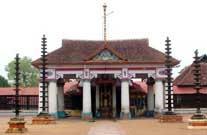 |
Vaikom Temple |
A historically significant temple in Kerala, it was here that people of the so-called lower castes challenged Hindu orthodoxy that prevented them from entering temples, by entering the Vaikom temple to offer prayers, in 1928 after the intervention of Mahatma Gandhi. The Vaikom temple is a temple of Lord Shiva in Kerala in South India. This temple is the most celebrated Shiva temples in the entire South India. The Vaikom temple is situated at 33 km distance from the south of Ernakulam and is at a distance of 40Km from the north of Kottayam by railroad between Ernakulam and Trivandrum.This temple is supposed to be one of the ancient temples and has seen ages. |
The worship in this Vaikom temple is done by offering food. In the earlier ancient days, food in varieties used to be cooked and offered to all the devotees.The Vaikom Mahadever is also known as ‘Annadaana Prabhu’ mainly because lots and lots of food are cooked and served here. This deity Shiva presents himself in many forms such as here he is known as Vaikom Mahadevar, while in the Panthirathi pooja in the early mornings he is referred to as Dakshinamurthy. He is also worshipped during the Uchcha Pooja as Kiraata Murthy in noon and as Satchitananda in the evenings. All the ancient temples are based on legends and the legends are worth believing as seeing is believing and we get to see various things very true that the legend imparts.The legend of Vaikom temple says that during the period of Ramayana, Khara the demon worshipped Shiva and attained three Shivalingams. He had one on each hand and the third Shivalingam in his mouth |
This temple has multitudes of visitors every year and they are highly impressed by these legends. Situated in a paradise like country amidst the beautiful natural surroundings and good climate, it invigorates its tourists to visit and revisit the holy sanctity of the Vaikom temple. |
|
|
| |
|
|
 |
Vadakkumnathan Temple |
Located in Trissur district, this is the venue of an annual temple festival. In this grand event, two rows of magnificently decorated tuskers, stand facing each other, while drummers beat out a traditional rhythm and representatives of the temples raise colored parasols over the elephants, bearing the images of the deities of neighboring temples. It is both an intense religious event and a colorful tourist attraction in Kerala that concludes with a grand display of fireworks.
Vadakkumnathan Temple also known asThenkailasam and Vrishabhachalam, is one of the largest and ancient Shivatemples in Kerala and is located at the heart of Thrissur town. This temple is a classic example of the Kerala style of architecture with beautiful murals delineating graphically, various episodes from theMahabharataThe shrines and the Koothambalam display exquisite vignettes carved in wood. According to popular lore, the temple was built by Parasurama. The sprawling Thekkinkadu maidan, encircling the Vadakumnathan temple, is the main venue of the Thrissur Pooram. The temple and the Mural paintings has been declared as a National Monument by the Union Government under the Ancient Monuments and Archaeological Sites and Remains Act |
The most striking feature of the temple is the Kuttambalam, which is the theatre hall for staging kuttu, an ancient dramatic form of art famous in Kerala.The Vadakkumnathan Temple is the venue of the world famous Pooram festival, celebrated annually in April-May. It attracts devotees and tourists from across the world and is one of the most popular festivals, combining the majestic elephant pageantry with the frenzied playing of drums and cymbals and rounded off with a fireworks extravaganza.
The temple opens between 3.00 AM to around 10.30 AM and then again from 4.00 PM till 8.30 PM, which is around when the Trippuka, the last rite of the day, finishes. Like several other temples in this region, only Hindus are allowed entry into the temple. |
|
|
| |
|
|
 |
Ettumanoor Temple |
This temple holds testimony to the cultural affluence of the temples ofKerala. The beautiful and intricate murals and fine architecture are major attractions to the tourists as well as connoisseurs of art. Ettumanoor (sometimes referred as Ettumanur ) is a major town in Kottayam District of Kerala, India, located 11 kilometers north-east of Kottayam town, 65 km from Cochin and 73 km from Cochin International Airport. The state Highway No.1 popularly known as the Main Central Road, passess through Ettumanoor, and is a major connecting link betweenPalai and beyond to the Western Ghats and to the commercial capital of Kerala - Kochi. Ettumanoor is en route to the tourist resort at wagamon and Poonjar. |
The name of the place had its origin from the word 'man oor' in Malayalam, which means the place of deer as deer means 'maan' and 'oor' means place. There is another version about the origin of the name Ettumanoor is about the former rulers of this place. Ettu in malayalam language means Eight, Mana means the house of a Brahmin and Oor in Tamil means village.This was a place ruled by the brahmins who lived in eight separate houses. Ettmanoor is a historical place as myths have says that the Pandavas and the sage Vyasa had established temple here. |
|
|
| |
|
|
 |
The Attukal Bhagavathy Temple |
The Attukal Bhagavathy Temple, one of the ancient temples of South India, is popularly described as Sabarimala of the Women, as women form the major portion of devotees. The Goddess in the temple of Attukal is worshipped as the Supreme Mother, creator of all living beings and the mighty preserver as well as destroyer of them all. The pilgrims from all over the country, who visit Sree Padmanabha Swamy Temple and worship the Lord, do not consider their visits complete without the visit to the shrine of the supreme Mother Attukalamma. Vishnumaya took the incarnation of Bhagavathy to annihilate the evil and protect the good in the world in the present Era namely Kaliyuga. |
According to mythology, Attukal Bhagavathy is supposed to be the divinised form of Kannaki, the famous heroine of Chilapathikaram, written by Elenkovadikal, the Tamil Poet. The story goes that after the destruction of ancient city of Madurai, Kannaki left the city and reached Kerala via Kanyakumari and on the way to Kodungalloor took a sojourn at Attukal. Kannaki is supposed to be the incarnation of Parvathy, the consort of Paramasiva. The all powerful and benign Attukal Bhagavathy reigns eternally supreme at Attukal and nurses devotees as a mother does her children. Thousands of devotees from far and near flock to the Temple to bend before the Goddess with awe and reverence to prostrate and redress their affliction and agony |
The Pongala Mahotsavam is the most important festival of Attukal Bhagavathy Temple. The offering of Pongala is a special temple practice prevalent in the southern part of Kerala and some parts of Tamilnadu. It is a ten-day programme commencing on the Karthika star of the Malayalam month of Makaram-Kumbham (February-March) and closing with the sacrificial offering known as Kuruthitharpanam at night. On the ninth day of the festival the world famous Attukal Pongala Mahotsavam takes place. The entire area of about 5 kilometre radius around temple with premises of houses of people of all caste, creed and religion, open fields, roads, commercial institutions, premises of Government offices etc. emerges as a consecrated ground for observing Pongala rituals for lakhs of women devotees assembling from different parts of Kerala and outside. The ceremony is exclusively confined to women folk and the enormous crowd, which gathers in Thiruvananthapuram on this auspicious day is reminiscent of the Kumbhamela Festival of North India. |
|
|
| |
|
|
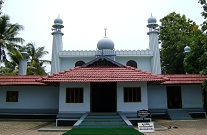 |
Cheraman Juma Masjid |
Believed to be the first mosque in India, Cheraman Juma Masjid where the Juma prayers were started is situated in Methala Village of Kodungalloor taluk in the state of Kerala. Built around 629 AD, the mosque is unique in its appearance as it is based on a mixture of Arab and traditional Kerala art and architecture.
|
The Oral tradition is that the Arab world had trade contacts with Kerala coast from very early times. Interaction with the Arabs brought Cheraman Perumal(the last Chera king to rule Cheranad (ancient Kerala)) closer to Islam. Later the king partitioned his kingdom among several chieftains for smooth governance, went to Mecca and converted to Islam and accepted the name Thajuddin. He married the sister of King of Jeddah and settled down there. As the tradition goes, Cheramanperumal, when he was
Other Mosques in India
Dargah Sharief
Haji Ali Mosque
Tomb of Sheikh Salim Chishti
Jama Masjid (The Friday Mosque)
More...
convinced of his imminent death, wrote letters to his relatives in Kerala seeking their help to propagate the tenets of Islam in Kerala. After his death, when Malik Bin Dinar (a disciple of Prophet Mohammed and a contemporary of Cheraman Perumal) came to Kerala, he brought the letters written by Perumal. The rulers of Kerala honoured the letter and permitted Malik Bin Dinar and his fellow Arab Muslim traders to establish mosques at different places in Kerala. This mosque at Kodungallur was the first to be established and Malik Bin Dinar himself became the first Ghazi of the mosque. Later Malik Bin Dinar appointed his son Habib Bin Malik as the next Ghazi, travelled all around Kerala establishing mosques in different parts of the state. |
|
|
| |
|
|
 |
Malik Dinar Mosque |
Malik Dinar Mosque is a historical mosque in Kasargod district of Kerala state,south India. Over the years, Kasargod acquired the considerable importance as a centre of Islam on the west coast. It is the site of one of the mosques believed to have been founded by Malik Ibn Dinar. The mosque, Juma Masjid, which is one of the best kept and most attractive in the district, is located at Thalangara. It contains the grave of Malik Ibn Mohammed, one of the descendants of Malik Ibn Dinar and the place is sacred to Muslims. Another notable mosque, in Kasaragod is the Theruvath Mosque which is in the centre of the town. |
|
|
| |
|
|
 |
Beemapalli Mosque |
This holy place of muslim pilgrimage lies about five kilometres southwest of Central Railway Station of Trivandrum , on the shoreline towards Poonthura. This famous place of worship is dedicated to Beema Beevi, a religious Muslim lady who is was bestowed with miraculous spiritual powers. She is a member of the family of Prophet Mohammed and is believed to have arrived from Mecca (Saudi Arabia) to preach the Muslim religion-Islam. Beema Beevi and her son Sayyidussaheed Maheen Aboobaker were interred here. |
The yearly ten-day Uroos festival at Beemapalli is observed in remembrance of Beema Beevi and her son. The most important part of the festival at Beemapalli is Chandanakudam Mahotsavam which is celebrated for ten days to commemorate Beema Beevi's death anniversary.It commences at the beginning of jama dul Akbar of the Hijra year and the place surges with massive crowds of pilgrims, irrespective of caste, creed and community. The pilgrims carry with them coin filled clay pots (kudams) for offerings and sandal wood paste (chandanam) is put on the surface of these pots. So this festival is known as 'Chandanakudam'. |
Several art forms like daharamuttu (done with sword) is performed within the mosque and Religious discussions, dance and Islamic songs are performed outside. At the culminating day of the festival, a flag from Beema Beevi's grave is taken out and a procession follows accompanied by the music of panchavadyam and barded eleplants. The offerings such as silk, flowers and oil that are made as offerings at Beemapalli are circulated among the pilgrims of this religious site. |
|
|
| |
|
|
|